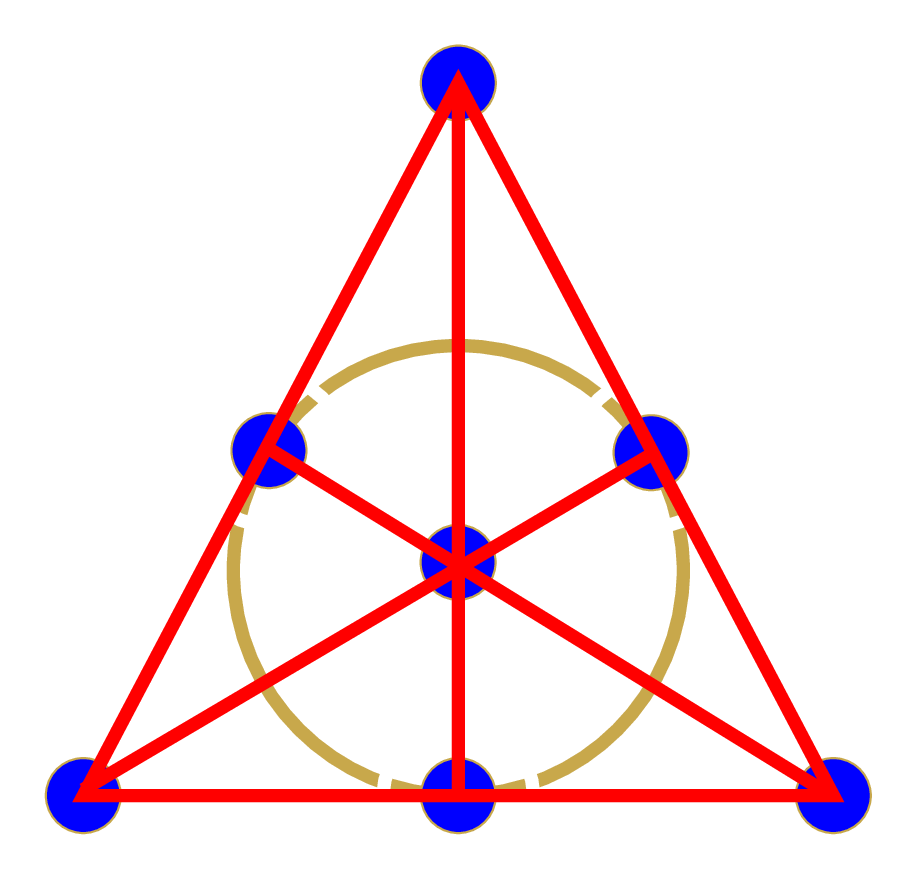
Classical Projective Spaces
A projective space is an incidence structure $\mathbb{P} = (P, G, I)$ where $P$ is a set of points, $G$ is a set of lines, and $I \subseteq P \times G$ is an incidence relation, subject to the following three axioms:
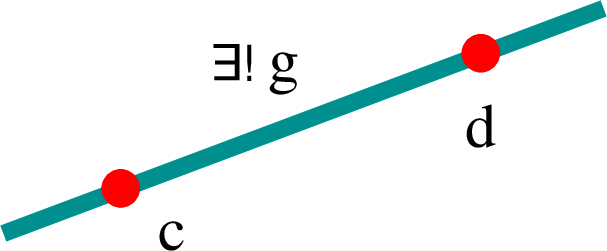
For every pair of distinct points there exists exactly one line incident with both.
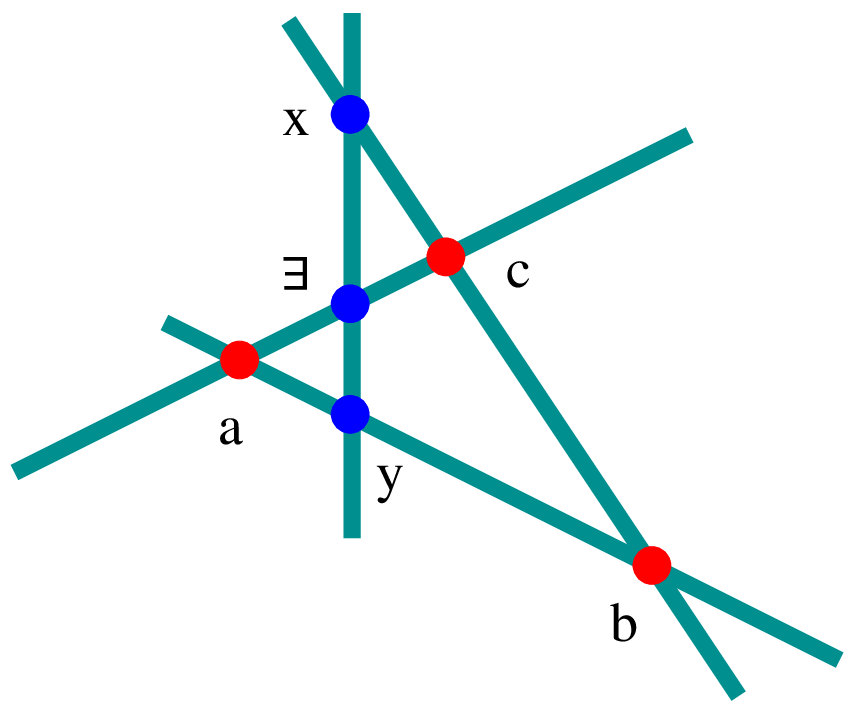
If a line is incident with two points of a triangle (not at the vertices), it is also incident with a point of the third side.
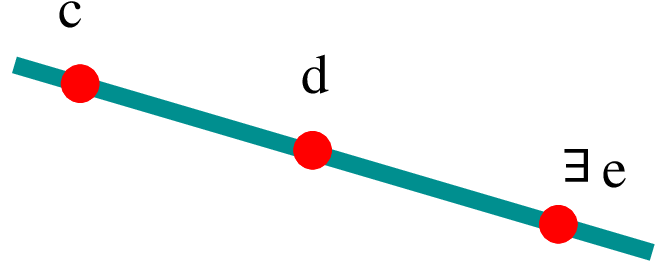
Every line is incident with at least three points.
The prototype is the classical projective space $\mathbb{P}(_FV)$ associated with a vector space $_FV$ over a (skew) field $F$: points are the $1\text{-dimensional}$ subspaces of $V$, lines are the $2\text{-dimensional}$ subspaces, and incidence is given by inclusion. For a finite field $F = \mathbb{F}_q$ this gives the well-known $\mathrm{PG}(n,q)$.
Desargues' Postulate
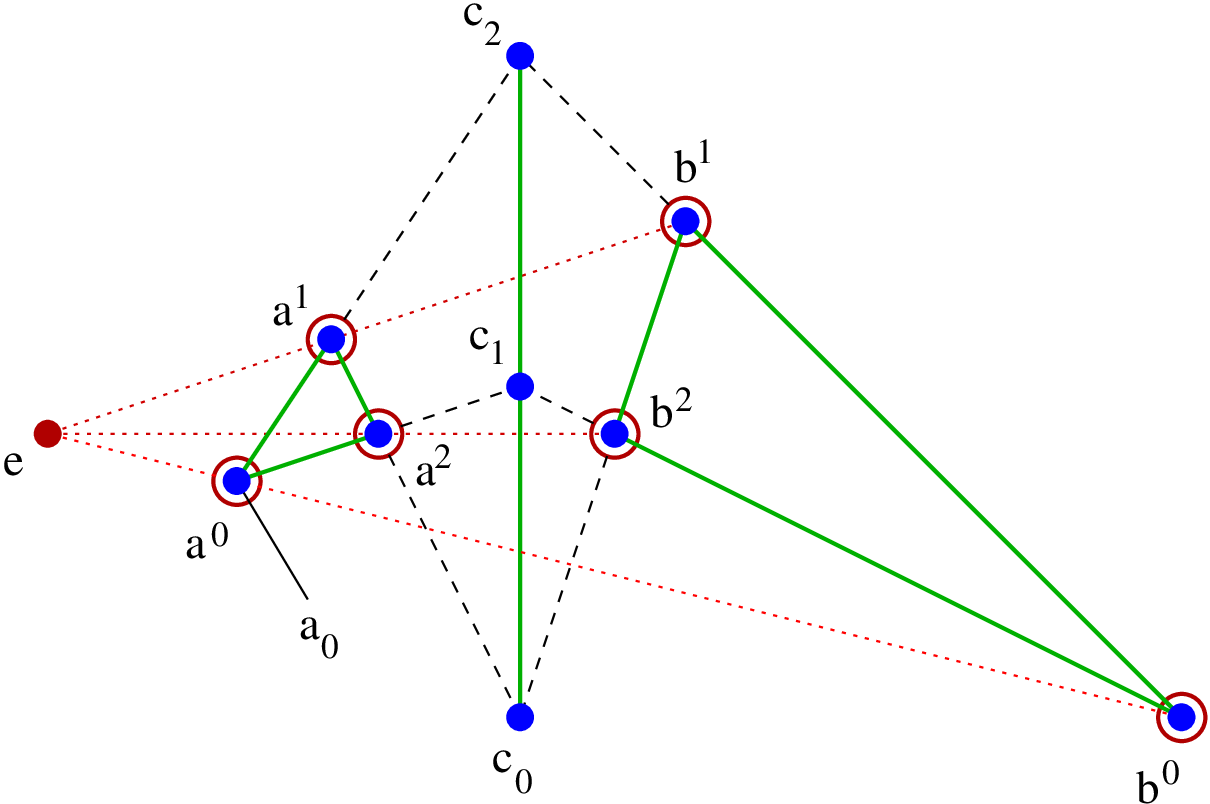
Let $a_0, a_1, a_2, b_0, b_1, b_2, e$ be points of $\mathbb{P}$ such that $(e, a_i, b_i)$ are collinear for all $i \in \{0,1,2\}$. Then the points $c_0, c_1, c_2$ are collinear, where $c_i := (a_j a_k) \cap (b_j b_k)$ for $\{i,j,k\} = \{0,1,2\}$.
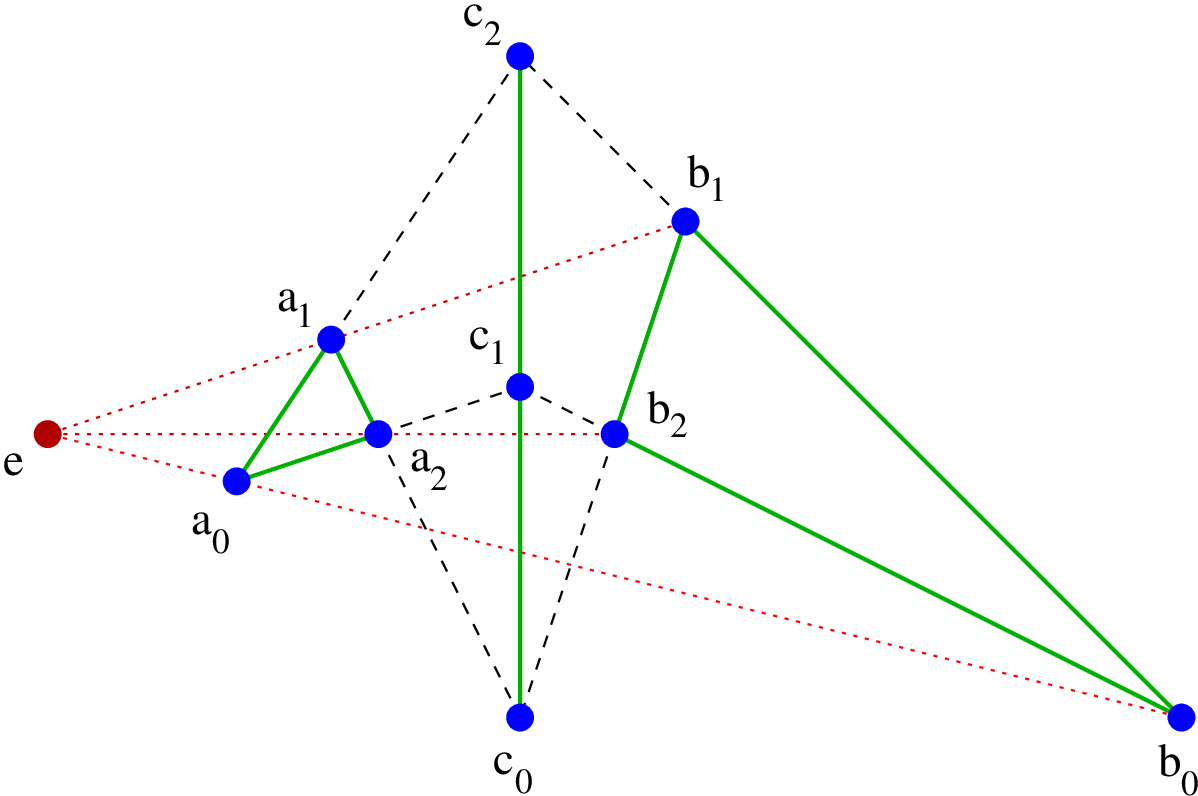
For a vector space $_FV$ the projective space $\mathbb{P} := \bigl(\bigl[{V \atop 1}\bigr],\, \bigl[{V\atop 2}\bigr]\bigr)$ is always Desarguesian.
Structure Theorems of Projective Geometry
(a) For a projective space $\mathbb{P}$ of dimension at least $3$ there exists a vector space $_FV$ such that $\mathbb{P} \cong \mathbb{P}(_FV)$.
(b) For a projective plane $\mathbb{P}$ the following are equivalent: $\mathbb{P}$ is Desarguesian; and $\mathbb{P} \cong \mathbb{P}(_FV)$ for some vector space $_FV$.
Every automorphism of a projective space $\mathbb{P}(_FV)$ of dimension at least $2$ is induced by a semi-linear mapping on $_FV$.
These classical theorems motivate the central question of module geometry: to what extent do analogous representation results hold when the underlying field $F$ is replaced by a ring $R$, and vector spaces are replaced by unital modules?
History of Generalizations
The project of extending the classical representation theorems to lattices and modules has a long history spanning several generations of algebraists and geometers:
- 1935 Birkhoff & Menger: Lattice-theoretic formulation of the structure theorem of projective geometry.
- 1935–37 J. von Neumann: Algebraic representation of complemented modular lattices with homogeneous basis of order $\geq 4$ by von Neumann regular rings.
- 1942/48 Baer & Inaba: Algebraic representation of primary lattices by modules over completely primary uniserial rings.
- 1954/69 Jónsson & Monk: Lattice-theoretic version of Desargues' postulate; extension of previous results to planar cases.
- 1968 Artmann: Partial coordinatization of modular lattices with homogeneous basis of order $\geq 4$.
- 1973 Faltings: Algebraic representation of large classes of modular lattices with a point system.
- 1982 Brehm: Representation of modular lattices with point-system by torsion-free left modules over left Ore domains.
- 1983 Day & Pickering: Partial coordinatization of Arguesian lattices by modules.
- 1989– Schmidt & Greferath: Algebraic representation of various classes of projective lattice geometries by modules.
Projective Lattice Geometry
A projective (lattice) geometry is a triple $G = (L, E, F)$ where $(L, +)$ is a complete lattice with join $+$, and $F \subseteq E$ are subsets of compact elements of $L$, satisfying the following three axioms.
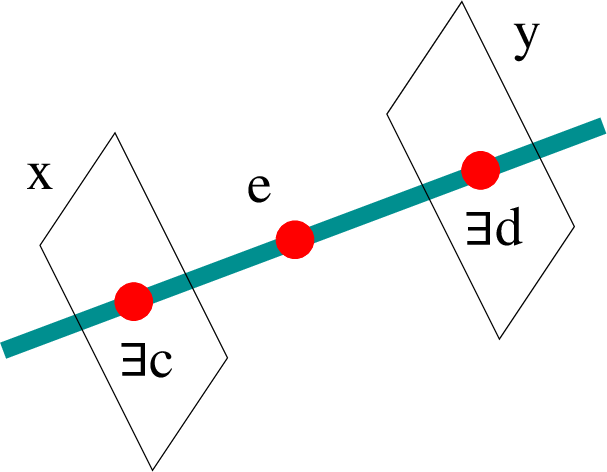
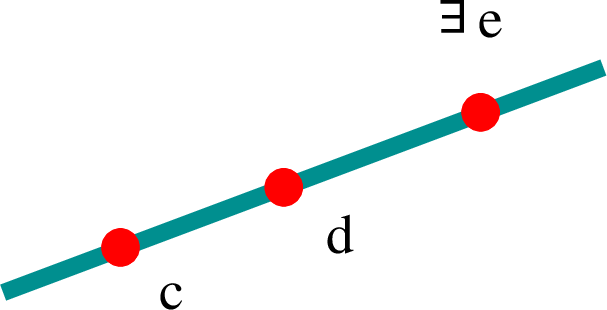
A triple $(c, d, e)$ of elements of $L$ is called balanced if $\;c + d \;=\; c + e \;=\; d + e.$
$x = \sum\{e \in E \mid e \le x\}$ for all $x \in L$.
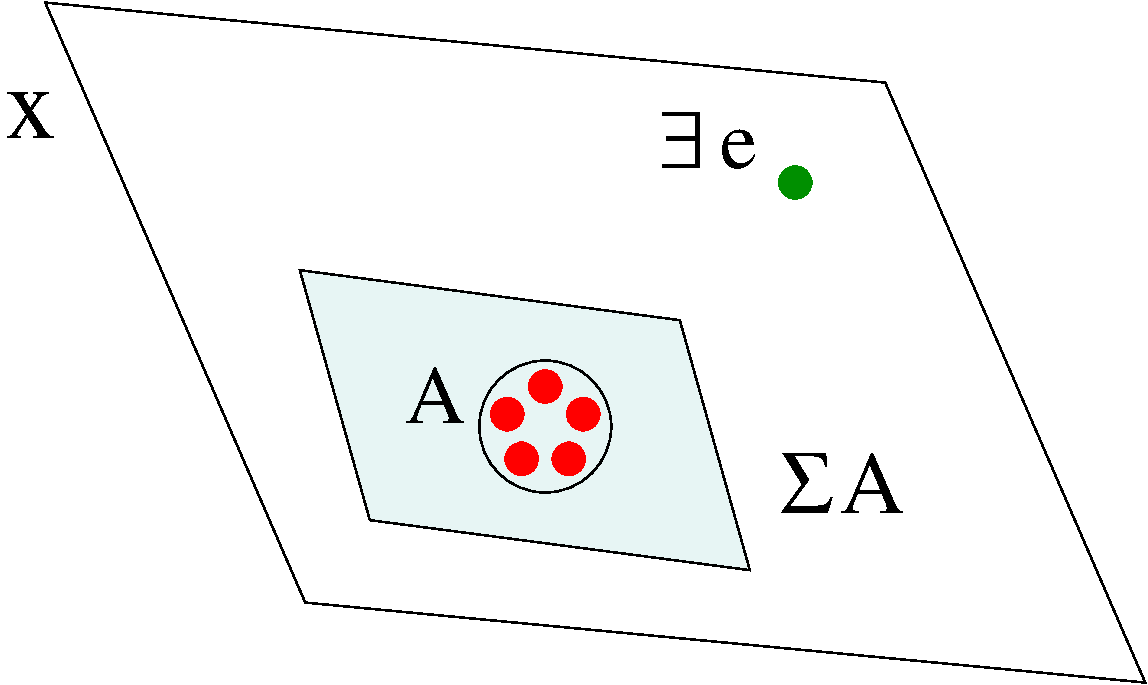
Equiv: For $A \subseteq E$ with $\sum A < x$ there exists a point $e \le x$ with $e \not\le \sum A$.
For $x,y\in L$ and $e\in E(x+y)$ there exist $c\in E(x)$ and $d\in E(y)$ such that $(c,d,e)$ is balanced.
For $c,d\in E$ there exists $e\in E$ such that $(c,d,e)$ is balanced.
Basic notions
- Elements of $E$ (or $F$) are called points (resp. free points). Joins of $n$ points are called $n\text{-generated}$ elements.
- A hyperplane is a complement of a free point. (N.B. such a complement does not necessarily exist.)
- A basis is an independent spanning family of free points; $\dim G := |\text{basis}| - 1$.
- For $x\in L$, the subgeometry is $G(x) := (x/0,\, E\cap x/0,\, F\cap x/0)$.
- Isomorphism: $(L,E,F)\cong(L',E',F')$ iff there is a lattice isomorphism $\varphi\colon L\to L'$ with $\varphi(E)=E'$ and $\varphi(F)=F'$.
A projective geometry $G=(L,E,F)$ is Desarguesian if and only if $L$ is an Arguesian lattice.
Every unital module $_RM$ naturally induces a Desarguesian projective geometry $\mathrm{PG}(_RM) := (L,E,F)$ with:
$L := \{U \mid U \leq {_RM}\}$ (ordered by inclusion), $\quad E := \{Rx \mid x\in M\}$, $\quad F := \{Rx \mid \lambda x\neq 0\ \forall\,\lambda\in R\setminus\{0\}\}$.
Free Points and Further Axioms
The subset $F \subseteq E$ of free points encodes additional regularity. Three further axioms govern its behaviour within the geometry:
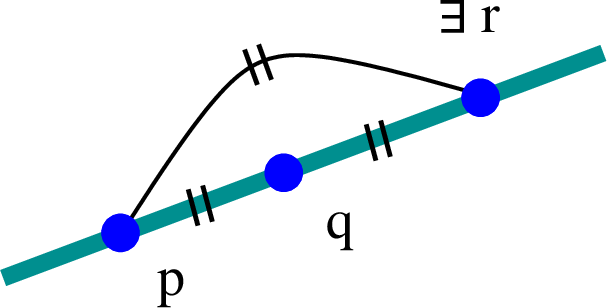
For $a,e\in E$ and $p\in F$ with $e+a = p\oplus a$ there exists $q\in F(e)$ such that $p\oplus a = q\oplus a$.
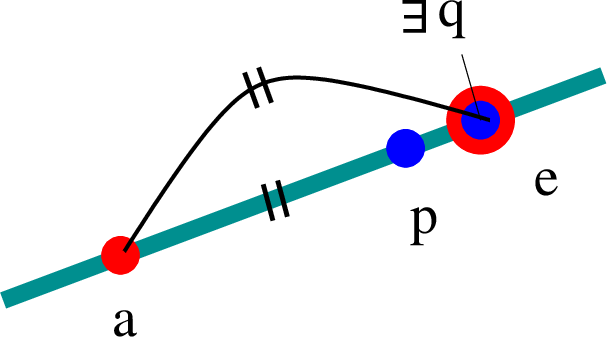
For $e\in E$ and $p\in F$ with $ep = 0$ there exists $q\in F$ such that $eq=0$ and $(e,p,q)$ is balanced.
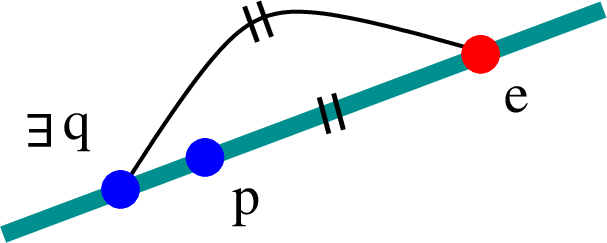
For $p,q\in F$ with $pq=0$ there exists $r\in F$ such that $(p,q,r)$ is directly balanced.
Desargues' Postulate in the lattice setting
Let $G=(L,E,F)$ be a projective geometry and $a^0,a^1,a^2,b^0,b^1,b^2,e$ points of $G$ with $e\leq a^i + b^i$ for all $i\in\{0,1,2\}$. Then there exist $a_i,b_i\in E$ and $c_i\in L$ such that for all $\{i,j,k\}=\{0,1,2\}$: $a_i\leq a^i$, $b_i\leq b^i$, and the triples $(e,a_i,b_i)$, $(c_i,a_j,a_k)$, $(c_i,b_j,b_k)$, and $(c_0,c_1,c_2)$ are all balanced.
Representation Theorems
The central programme is to identify which projective lattice geometries are module-induced, i.e.\ isomorphic to $\mathrm{PG}(_RM)$ for some ring $R$ and module $_RM$. A series of results by Greferath and Schmidt gives increasingly general answers:
In a Desarguesian projective geometry, the subgeometry of every at-least-$1\text{-dimensional}$ hyperplane is module-induced.
A projective geometry satisfies $Q^k_n$ if for any $k\text{-element}$ family of $n\text{-generated}$ elements there exists a free point lying disjoint from each of them.
Every projective geometry containing a free hyperplane whose subgeometry satisfies $Q^2_2$ is module-induced.
Every projective geometry of infinite dimension is module-induced.
Characterization via chain rings
A unital ring $R$ is a right chain ring if its right ideals form a chain under inclusion. A projective geometry is point-irreducible if each nonzero point is join-irreducible, and has the U-property if each point is contained in a complemented free point.
For a finitely but not $5\text{-generated}$ projective geometry $G$, the following are equivalent: (a) $G$ is point-irreducible with the U-property; (b) $G$ is induced by a free left module over a right chain ring.
Characterization via stable rings
A ring $R$ is $k\text{-stable}$ if whenever $\alpha_i\gamma_i + \beta_i\delta_i$ is a unit for $i=1,\ldots,k$, there exist $\gamma,\delta\in R$ such that all $\alpha_i\gamma + \beta_i\delta$ are units. (Every ring is $1\text{-stable}$; $2\text{-stable}$ rings have stable range $1$ in the sense of Bass.)
A projective geometry is $k\text{-stable}$ if any $k$ complemented free points have a common complement.
$R$ is a proper right Bézout ring if for all $\alpha,\beta\in R$ there exist $\gamma,\delta,\varepsilon\in R$ with $\gamma\delta=\alpha$, $\gamma\varepsilon=\beta$, and $\delta R + \varepsilon R = R$.
For all $k\geq 2$, $n\geq 3$ with $k+n\geq 7$, the following are equivalent for a projective geometry $G$: (a) $G$ is $k\text{-stable}$ of dimension $n$ with the U-property; (b) $G \cong G(_RR^{n+1})$ where $R$ is a $k\text{-stable}$ proper right Bézout ring.
A projective geometry is a Cohn geometry if all nonzero points are free, and the join of any disjoint pair of free points is never a point.
For a Cohn geometry $G$ of dimension $n\geq 3$, the following are equivalent: (a) $G$ has the U-property; (b) $G \cong \mathrm{PG}(_RR^{n+1})$ where $R$ is a right Bézout domain.